
Community Champion Spotlight: Ariel Gutierrez and Ruth Goldberg
To honor Human Trafficking Awareness Day, each week in January we will be posting a “Community Champion Spotlight” highlighting 2 individuals who exemplify excellent anti-trafficking work in New Orleans.
Our first highlight features members of funded GNOHTTF service provider agencies. Both were nominated because of their leadership, commitment to treating victims/survivors with dignity, and dedication to collaboration. They have raised the bar on survivor services in New Orleans. They are Ariel Gutierrez of the New Orleans Family Justice Center, and Ruth Goldberg of
To honor Human Trafficking Awareness Month, each week in January we will be highlighting 2 individuals who have gone above and beyond in the Greater New Orleans community to serve victims and survivors of human trafficking. This highlight is the “Community Champion Spotlight”. Each individual was nominated by Task Force members. Community champions represent a variety of different disciplines and perspectives from the anti-trafficking movement.
Our first highlight features members of funded GNOHTTF service provider agencies. Both were nominated because of their leadership, commitment to treating victims/survivors with dignity, and dedication to collaboration. They have raised the bar on survivor services in New Orleans. They are Ariel Gutierrez of the New Orleans Family Justice Center, and Ruth Goldberg of Jewish Family Service of Greater new Orleans.
Thank you Ariel and Ruth for all you do for our community! We're so lucky to have you in the Greater New Orleans community.
—-
Ariel Gutierrez
Case Manager, New Orleans Family Justice Center
"Having someone present with [survivors] on an ongoing basis can be a crucial part of accessing help that they might have otherwise not felt empowered to."
What is your role in the Greater New Orleans community?
Connecting survivors to local support services, and when appropriate helping them advocate for their needs in medical/legal/law enforcement settings. When clients experience long-term or multiple victimizations, their ability to engage with or access services that allow them to thrive can be diminished, and it’s my job to help them connect the dots as much as possible. Because trafficking survivors often come from marginalized or vulnerable communities, having someone present with them on an ongoing basis can be a crucial part of accessing help that they might have otherwise not felt empowered to. Although we all know that there is a broad spectrum of trafficking survivors (what they look like, their previous life experiences, etc.), a client’s social capital and mobility can have a significant impact on their ongoing/long-term recovery and well-being.
What has been your most successful experience working in the anti-trafficking movement?
Anytime a client’s case makes significant progress is memorable – when a valuable resource pulls through, or we get confirmation that someone is interested in taking their case, or that legal support for them becomes a possibility. In these moments it can feel like all the puzzle pieces are starting to come together, especially when the client has more intensive needs.
What has been your favorite aspect of collaborating among task force partners?
Building relationships with task force partners, and working together toward a common goal, has been incredibly rewarding. There are many task force members that I’d never otherwise cross paths with or have an opportunity to collaborate with (especially when their job descriptions are so different from my own); when we’re able to collaborate in service of a common goal, and addressing this common goal from different perspectives, is something that might not have been possible were it not for the GNOHTTF.
What are Task Force members saying about Ariel?
"Ariel's willingness to cooperation with other organizations has improved service coordination in New Orleans."
—-
Ruth Goldberg
Bilingual Case Manager, Jewish Family Service of Greater New Orleans
"It is ultimately our actions, rather than our words, that will prove to survivors of human trafficking that we honor their dignity, self-worth and humanity."
What is your role in the Greater New Orleans community?
I provide intensive case management or clinical counseling to survivors of human trafficking with the understanding that their right to self-determination will always be respected. The majority of the survivors whom I have helped have been from Central America.
What has been your favorite aspect of collaborating among task force partners?
It is always inspiring to come across other individuals who are just as passionate, committed and determined to be of service to survivors of human trafficking. I am so impressed by and deeply grateful to organizations such as Family Justice Center and Eden House for the absolutely incredible, holistic work that they are doing in assisting survivors of human trafficking. It was Margaret Mead, an American cultural anthropologist, who said, “Never doubt that a small group of thoughtful, committed citizens can change the world; indeed, it’s the only thing that ever has.”
Anything else you'd like to share?
This work is extremely difficult – resources tend to be very limited and systems are often strained, especially for foreign born survivors of human trafficking. For these reasons, I believe that if there is anything I can reasonably do or advocate for, at my level as a Case Manager or Counselor, to reduce “roadblocks” or “barriers” to assistance for survivors of human trafficking, then I should try my very best to do it – For it is ultimately our actions, rather than our words, that will prove to survivors of human trafficking that we honor their dignity, self-worth and humanity.
What are Task Force members saying about Ruth?
"Ruth is persistent in her quest to ensure every survivor has access to the services that they need. She's creative, and collaborative, and kind."
—-

Biz New Orleans: The Cost Of Sex Trafficking And My Days Inside Jeffrey Epstein’s Mansion
By Leslie T. Snadowsky | July 11th, 2019
Leslie T. Snadowsky explores her connection to the home of Jeffery Epstein, and her shock to discover what happened within those walls. She includes interviews from individuals from Covenant House New Orleans and the Greater New Orleans Human Trafficking Task Force, who explore the misconceptions around human trafficking, and why trafficking often goes unnoticed.
Read more at: https://www.bizneworleans.com/the-cost-of-sex-trafficking-and-my-days-inside-jeffrey-epsteins-mansion/

“Opening Doors: Louisiana Human Trafficking Survivor Housing Report” reveals lack of beds, limited housing options for trafficking survivors
The Greater New Orleans Human Trafficking Task Force is proud to share its new report: Opening Doors: Louisiana Human Trafficking Survivor Housing Report. “Opening Doors” was created as a final product of a year-long community-based project to better understand trafficking survivor housing options in Louisiana.
The Greater New Orleans Human Trafficking Task Force is proud to share its new report: Opening Doors: Louisiana Human Trafficking Survivor Housing Report. “Opening Doors” was created as a final product of a year-long community-based project to better understand trafficking survivor housing options in Louisiana. The housing report was created by integrating survey data of three key stakeholders in the housing process: housing providers, housing advocates, and trafficking survivors. This report is the first of its kind in Louisiana- collecting data to take a data-informed approach to understand the current housing landscape. Our goal for this report is to spark a conversation about survivor housing access that is guided by feedback from housing providers and also grounded in survivors' lived experiences. We hope this information can be a catalyst for future in-depth analysis of the housing system.
Access Phase
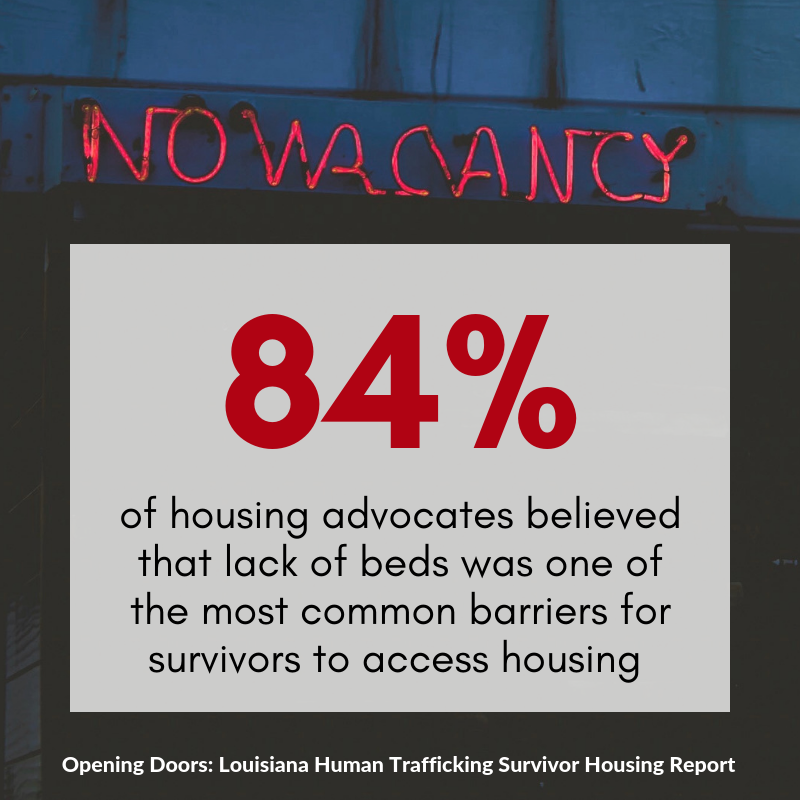
The report found that there are few specialized housing options in Louisiana- only 46 total, which are only available to female sex trafficking survivors. The report found that 84% of housing advocates serving trafficking survivors believe that there are not enough general housing or specialized housing options for trafficking survivors in Louisiana. See the flow chart below to learn which trafficking survivors have access to specialized housing services. Adults with children, labor trafficking survivors, males, and trans/non-binary/gender non-conforming individuals had fewer general housing options and no specialized housing options.


Process Phase
This report illuminates a contrast between the perspectives of housing providers and housing advocates in the process phase of housing. Important topics that highlight the contrasting points of view include: perceptions of bed availability and shelter fullness, intake process speed, and intake rigidity. For example, housing providers have a wide range of responses about how often they are full, which contrasted with housing advocate perception that beds are constantly full or unavailable. 56% of housing providers said they are full 60% or more of the time. Housing advocates identified that many clients were being screened out during the intake process, due to issues like history of behavioral health issues, mental health, criminal history, substance use, and cooperation with law enforcement.

Service Phase
Housing providers and housing advocates expressed varying degrees of success housing survivors. Stabilization was identified as the top success in the service phase by both housing providers and advocates. Stabilization is a process of helping survivors feel more safe, addressing basic needs, and addressing the survivor's acute needs. The most common successes housing providers identified were short and long term stability; and the most common success identified by housing advocates was general stabilization.
However, when we coded the responses of housing advocates we found that “no success” was the second most common phrase used to describe successes in the housing process. Housing advocates reported that a large portion of the survivors they serve do not make it into housing programs due to factors including identity, bed availability, and behavioral health. The most common challenge that housing providers identified in the service phase of housing is that survivors prematurely exit housing programs (such as running away, relapsing, or returning to their abuser).


Moving Forward: Next steps
This report marks the beginning of a data-informed conversation about housing for human trafficking survivors in Louisiana. Here are some ways that the community can take steps to build upon this information:
Convene a summit with key stakeholders (survivors, housing providers, advocates) to discuss the success and gaps identified in this report to discuss ways to improve survivor outcomes in the housing process.
Implement this housing project for a second iteration in 2-3 years to see how the landscape has changed in Louisiana.
Apply for funding to support the expansion of existing housing programs or development of trauma-informed, survivor-centered housing programs that serve trafficking survivors- particularly those who do not currently have specialized housing options.
Support future research that explore topics identified as key issues in this report, such as: how often shelters are full or at-capacity, which client demographics are successfully accessing housing, what housing success looks like for trafficking survivors and providers, and what alternative housing options (outside of the housing service provider landscape assessed in this report, such as therapeutic foster care programs) are available to trafficking survivors.
Conduct program evaluations of existing housing programs to understand client outcomes in the service phase of the housing process, and assess potential opportunities to improve housing accessibility and outcomes for survivors.
To learn more about the housing project and to download the report, visit http://www.nolatrafficking.org/research.
--
The Greater New Orleans Human Trafficking Task Force is a coalition of more than 80 state, civil society, and citizen organizers, the Task Force is committed to the prevention of human trafficking in the Greater New Orleans area through education, outreach, and collaboration. The Task Force’s primary goal is to collaborate in sharing and disseminating information, contacts, and protocols related to the existence, prevention, and response to human trafficking in New Orleans.

WDSU: Human trafficking task force unveils new plan to help victims
Reporter Aubrey Killion of WDSU highlights the GNOHTTF’s “All Work, No Pay?” outreach and awareness campaign. Read the full article and view the news clip here. You can access the free outreach and awareness materials here.
Reporter Aubrey Killion of WDSU highlights the GNOHTTF’s “All Work, No Pay?” outreach and awareness campaign. Read the full article and view the news clip here. You can access the free outreach and awareness materials here.
—
Aubrey Killion, April 23, 2019
NEW ORLEANS — The Greater New Orleans Human Trafficking Task Force unveiled a new approach to fight the critical problem.
They have put together flyers and pamphlets for the public free of charge. They are available in seven languages.
Since 2016, the task force has helped more than 340 human trafficking victims.
The task force wants trafficking victims to know it's not just sexual abuse, victims can be exploited in other ways.
The pamphlets have a list of questions and resources for victims.
The task force encourages people to put the flyers and pamphlets up in churches, youth centers and businesses.
"We do have survivors who experienced familial trafficking. They were trafficked by a family member or a partner like a husband, boyfriend girlfriend, so those are some of the cases that we see quite regularly that I think the general public would be shocked to know is that a somewhat common place in the survivor experiences," task force coordinator Leanne McCallum said.
The National Human Trafficking hotline is 1-888-3737-888.
To access the free pamphlets, click here.

WVUE: Report: More human traffic victims reported in Louisiana
By Rilwan Balogun | April 1, 2019 at 3:49 PM CDT - Updated April 1 at 5:04 PM
NEW ORLEANS (WVUE) - New state numbers show the amount of sex or labor trafficking victims climbed 9% last year.
“This is here in our state. It is in Louisiana,” said Christy Tate with Department of Children and Family Services. “I think many times people associate trafficking as being somewhere far away, but it’s here. It’s in our backyards.”
Read more at: https://www.fox8live.com/2019/04/01/report-more-human-traffic-victims-reported-louisiana/

Special Guest Appearance on Red X Podcast
The GNOHTTF Task Force Coordinator Leanne McCallum sat down with Red X Podcast, a podcast "that exists to raise awareness of human trafficking in North America and empower everyday people to work with their local municipalities to create a safe place for citizens, a hostile environment for criminals, and a second chance for survivors." On the podcast, Leanne discusses survivor services and coordinated response for trafficking victims in the Greater New Orleans region.
The GNOHTTF Task Force Coordinator Leanne McCallum sat down with Red X Podcast, a podcast "that exists to raise awareness of human trafficking in North America and empower everyday people to work with their local municipalities to create a safe place for citizens, a hostile environment for criminals, and a second chance for survivors." On the podcast, Leanne discusses survivor services and coordinated response for trafficking victims in the Greater New Orleans region.
Listen to the podcast here.

WWL TV: Task Force Fights Trafficking in NOLA
Leanne McCallum, Task Force Coordinator of the Greater New Orleans Human Trafficking Task Force, sits down with Meghan to discuss what the task force would like to accomplish when it comes to human trafficking.
January 25, 2019: Leanne McCallum, Task Force Coordinator of the Greater New Orleans Human Trafficking Task Force, sits down with Meghan from WWL TV to discuss what the task force would like to accomplish when it comes to human trafficking.
View the news clip at: https://www.wwltv.com/video/news/local/morning-show/task-force-fights-human-trafficking-in-nola/289-3af5cdaf-3989-4ab9-bb1e-9508be30fa09

Community Champion Spotlight: Laura Murphy and Nadia Lee
Our fourth highlight features two community members who are sharing the truth about trafficking experiences in unique ways. Dr. Laura Murphy conducts research on human trafficking, highlighting survivor experiences and leading the community through evidence-based understandings of the crime. Nadia Lee is a Survivor Leader and Eden House employee who shares her lived experience to provide prevention education to at-risk youth.
To honor Human Trafficking Awareness Month, each week in January we will be highlighting 2 individuals who have gone above and beyond in the Greater New Orleans community to serve victims and survivors of human trafficking. This highlight is the “Community Champion Spotlight”. Each individual was nominated by Task Force members. Community champions represent a variety of different disciplines and perspectives from the anti-trafficking movement.
Our fourth highlight features two community members who are sharing the truth about trafficking experiences in unique ways. Dr. Laura Murphy conducts research on human trafficking, highlighting survivor experiences and leading the community through evidence-based understandings of the crime. Nadia Lee is a Survivor Leader and Eden House employee who shares her lived experience to provide prevention education to at-risk youth.
Thank you Nadia and Dr. Murphy for all you do for our community! We're so lucky to have you in the Greater New Orleans community.
—-
Laura Murphy
Associate Professor and Director, Modern Slavery Research Project, Loyola University New Orleans
"The responsibility for addressing trafficking is on all our shoulders as a society because it only exists because we do not provide adequate resources and jobs for our citizens."
What is your role in the Greater New Orleans community?
I serve as the Evaluator and training consultant for the task force. Through the Modern Slavery Research Project, I provide research and training for organizations that address human trafficking.
What has been your most successful experience working in the anti-trafficking movement?
The work that has been most meaningful has been conducting the study of trafficking among homeless youth in the city. The young people we interviewed for that project provided invaluable insight into the economic roots of trafficking in our community and the vulnerabilities young people in our community face. That study provided the groundwork for our extension of that study across the United States and Canada, leading to a blueprint for addressing trafficking among homeless youth.
What has been your favorite aspect of collaborating among task force partners?
It has been encouraging to see collaboration across sectors increase in the eight years I’ve been working on this issue in the city. I believe that everyone can agree that no one should be exploited or unpaid at work. The responsibility for addressing trafficking is on all our shoulders as a society because it only exists because we do not provide adequate resources and jobs for our citizens. I am heartened by the increased commitment of people across all industries and communities to ensure that everyone has the resources they need to protect themselves against forced labor situations.
What are Task Force members saying about Laura?
"Dr. Murphy leads the community with her commitment to truth-telling. Her contributions to the community have illuminated the needs of vulnerable populations like homeless youth.”
—-
Nadia Lee
Prevention Program Coordinator, Eden House NOLA
“The more we as a community equip our youth with the knowledge, tools, and resources that are needed, hopefully we’ll start to see a decline in the number of teens being forced into that life.”
What is your role in the Greater New Orleans community?
I provide prevention education and outreach throughout the Greater New Orleans Area. As a Survivor Leader, I leverage my story to educate at-risk youth on the issue of human trafficking. Gearing them with necessary tools to identify, resist, and prevent human trafficking, commercial sexual exploitation, and gender-based violence.
What has been your favorite aspect of collaborating among task force partners?
My favorite part is, and always has been, working with the youth of our community. Clearing up misconceptions and myths that are associated with and around human trafficking, really opens their eyes in a way that they begin to understand the importance of being aware of harmful people and their surroundings at all times
Anything else you'd like to share?
We cannot overlook our youth. The average age that a teen is forced into sex trafficking is 12 – 14 years old. This movement starts with these boys and girls. The more we as a community equip them with the knowledge, tools, and resources that are needed, hopefully we’ll start to see a decline in the number of teens being forced into that life.
What are Task Force members saying about Nadia?
“Nadia is a warrior who is sharing her truth to help others. Her leadership and strength shows everyone how powerful survivors are!”
—-

NOLA.com: Here’s what experts want you to know about human trafficking in New Orleans
Human trafficking experts and law enforcement officials spoke at a panel Wednesday (Jan. 23) at the Mid-City Library to discuss ways to identify and respond to human trafficking in New Orleans.
January 23rd, 2019: Human trafficking experts and law enforcement officials from the Greater New Orleans Human Trafficking Task Force spoke at a panel Wednesday (Jan. 23) at the Mid-City Library to discuss ways to identify and respond to human trafficking in New Orleans.
Read the coverage of this Task Force event: https://www.nola.com/crime/2019/01/heres-what-experts-want-you-to-know-about-human-trafficking-in-new-orleans.html

Loyola Maroon: Human trafficking forum fights social misconceptions
Loyola University New Orleans’ The Maroon covers a community event provided by the Greater New Orleans Human Trafficking Task Force and Eden House New Orleans in observation of Human Trafficking Awareness Day. January 11, 2019.
Loyola University New Orleans: The Maroon
Human trafficking forum fights social misconceptions
Read the blog directly on Loyola’s The Maroon website at https://www.loyolamaroon.com/10020695/news/human-trafficking-forum-fights-social-misconceptions/
Written by Andrew Lang
January 19, 2019
—
Though SGA President Sierra Ambrose is often involved in promotion of on-campus events, a Jan. 11 forum on human trafficking felt a little more personal than most.
“Growing up, I know that my mom told me a story about how she was almost raped and kidnapped, so that kind of fed into the reasons why I wanted to promote [the forum] and Take Back the Night,” Ambrose said.
Loyola’s Student Government Association, along with the Women’s Resource Center, hosted the forum on National Human Trafficking Awareness Day. More than a dozen people attended the event, held in the Audubon Room in the Danna Student Center.
Ambrose did most of the work to set up the forum, according to Patricia Boyett, director of the Women’s Resource Center. Boyett said Ambrose approached her the night before winter break with the idea to host the panel.
Susanne Dietzel, executive director of Eden House, a recovery home for victims of human trafficking, and Leanne McCallum, task force coordinator for the Greater New Orleans Human Trafficking Task Force, served as panelists. They broke down misconceptions about human trafficking and sought to raise awareness by explaining the issue more thoroughly.
McCallum used the movie “Taken” as a way to deconstruct some of the mainstream misconceptions surrounding conversations about human trafficking, and she pointed out possible consequences of those fictional narratives.
McCallum said human trafficking victims are not always white girls kidnapped by foreign nationals. Many people, she said, are controlled by other methods like economics or coercion. McCallum also explained that not all human trafficking is sex trafficking; many victims are also being used as forced labor.
“I think, in the past when we had framed human trafficking as an issue based on white slavery and based on kidnapping, what happens is that a lot of victims were never identified,” McCallum said.
She said accurate trafficking statistics are hard to find because many cases of human trafficking are misidentified as prostitution.
McCallum added that certain factors make New Orleanians more susceptible to human trafficking than other cities’ residents.
“With New Orleans — with the high poverty rate, with some of the issues with healthcare access, poverty, housing insecurity — there are a lot of vulnerabilities that our community members face,” McCallum said.
Ambrose said issues with human trafficking need to be addressed because even if students on campus feel separated from the problem, it persists close to home.
“[The issues] don’t just affect outside the Loyola community,” Ambrose said. “It also affects us, as well, because we are merged into Orleans Parish, so whatever affects them affects us.”
Music industry junior Syane Soriano attended the panel discussion and said it’s important for people to look at the complexities of human trafficking.
“It’s important because a lot of people just think sex trafficking is just people kidnapping girls and putting them in their trunk and then leaving,” Soriano said.
Ambrose said SGA hopes to plan a follow-up event, and she hopes last week’s forum helped educate people on how to help victims of human trafficking.
“Sometimes, it’s not always just standing in solidarity with them – that’s great – but also going the extra mile and making sure that there won’t be another victim,” Ambrose said.
Dietzel said she strives to shift the conversation about human trafficking, socially and politically, away from current attitudes that it is an issue to be resolved by a select few.
“This is way more than a women’s issue,” Dietzel said. “This affects us all.”

Press Release: National Human Trafficking Awareness Day
Recognizing January 11th as National Human Trafficking Awareness Day, the Greater New Orleans Human Trafficking Task Force (GNOHTTF) announces its continued, multi-year funding from the United States Department of Justice beginning in February 2019.
Recognizing January 11th as National Human Trafficking Awareness Day, the Greater New Orleans Human Trafficking Task Force (GNOHTTF) announces its continued, multi-year funding from the United States Department of Justice beginning in February 2019. Evolving from the 2006 Louisiana Human Trafficking Task Force, through the 2012 New Orleans Human Trafficking Working Group, the Greater New Orleans Human Trafficking Task Force was established in 2015 to have a victim-centered, multi-disciplinary approach, coordinating private and public agencies to liberate people trafficked -- often from coercive and violent circumstances. This funding grants the GNOHTTF funding for 3 more years to continue its work combating human trafficking in the Greater New Orleans region.
Bringing the reality of human trafficking in the Greater New Orleans metropolitan area, the Task Force announces two events – a panel discussion January 23th from 6:00-7:30pm at the Mid-City Library, 4149 Canal Street, where Task Force members will dialogue and answer questions on what responders in the New Orleans area are doing liberate and serve trafficking victims and survivors. On Thursday, January 24th, after presenting to the New Orleans City Council, the Greater New Orleans Human Task Force will host an evening of networking, where former Louisiana Poet Laureate, Julie Kane will read an original poem created for this event.
One of the achievements of the Task Force is the completion of the Louisiana Human Trafficking Survivor Housing Resource Guide – an in-depth guide including 18 shelter providers in Louisiana who serve trafficking survivors, with a digital copy is available at www.nolatrafficking.org- and the forthcoming Opening Doors: Louisiana Human Trafficking Housing Report which reviews the shelter landscape in Louisiana. Additionally, the Task Force is launching its “All Work, No Pay?” awareness campaign that includes an awareness poster and an outreach pamphlet in a variety of languages including: English, Spanish, French, Vietnamese, Chinese, Thai, and Arabic. This campaign affirms the Task Force’s commitment to inclusive, trauma-informed awareness materials that shows a diverse range of identities and work environments.
For further information on the Greater New Orleans Human Trafficking Task Force, contact Leanne McCallum, Task Force Coordinator at 504-584-1170, or at info@nolatrafficking.org.
—-

Community Champion Spotlight: Storm Ehlers and Samantha Sahl
Each week for the month of January, we will be highlighting individuals who have gone above and beyond in the Greater New Orleans community to serve victims and survivors of human trafficking. Each individual was nominated by Task Force members. Community champions represent a variety of different disciplines and perspectives from the anti-trafficking movement.
Our second highlight features innovators who are bringing promising practices to the New Orleans juvenile justice system: Storm Ehlers and Samantha Sahl. These young professionals were nominated because of their commitment to evidence-based practices and continuous engagement and collaboration with community members.
To honor Human Trafficking Awareness Month, each week in January we will be highlighting 2 individuals who have gone above and beyond in the Greater New Orleans community to serve victims and survivors of human trafficking. This highlight is the “Community Champion Spotlight”. Each individual was nominated by Task Force members. Community champions represent a variety of different disciplines and perspectives from the anti-trafficking movement.
Our second highlight features innovators who are bringing new promising practices to the New Orleans juvenile justice system. This dynamic duo is helping to make the Orleans Parish Juvenile Court a leader in trauma-informed human trafficking response for system involved youth. These young professionals were nominated because of their commitment to evidence-based practices, and continuous engagement and collaboration with community members.
Thank you Storm and Sam for all you do for our community! We're so lucky to have you in the Greater New Orleans community.
—-
Storm Ehlers
Court Attorney, Orleans Parish Juvenile Court
""In this field, information is the fire clearing the fields for sustainable new growth, and it has been magical to watch it happen."
What is your role in the Greater New Orleans community?
As Court Attorney, I am a supporting administrative staff to the Judges of the Juvenile Court. I’ve researched, written, trained, and provided training on the topic of juvenile human trafficking and the ways in which the court can improve infrastructure and processes for dealing with these cases. I’ve drafted protocols and procedures, written grants to increase personnel and training and technical assistance (TTA) on the topic at the court, led TTA projects in this area, participated in task forces and represented the court in this area at local, regional, and national stakeholder meetings and conferences.
What has been your most successful experience working in the anti-trafficking movement?
There have been so many successes working with GNOHTTF and the anti-trafficking movement – seeing an entire workforce become educated on what trafficking is and how to begin to identify and address it, watching judges and community members become champions in New Orleans for child victims, collaborating with jurisdictions and professionals across the US and even in other countries, creating strong partnerships among agencies doing work with youth and adult victims, seeing agencies grow in their ability to provide services, watching new generations of young students find interest and sustain a drive for change in this area, and most importantly seeing youth begin to have access to help and systems of change, even among all the setbacks and challenges. In this field, information is the fire clearing the fields for sustainable new growth and it’s been magical to watch it happen.
What has been your favorite aspect of collaborating among task force partners?
My favorite aspect is when the systems we work in are actually working together and members in each system are communicating, supporting each other and the youth in question. Even temporary solutions to a youth’s stability can have a lasting effect on the outcomes for that youth and watching a group of professionals work together to support those outcomes is always heartwarming and encourages me to keep working.
Anything else you'd like to share?
The most important aspect of this work is continual self-care. No matter what aspect of the system you are working in on this topic, even the most far removed research desk job, even as a student intern, even as a short term volunteer, it’s important to remember to take care of yourself or else you can’t begin to show up for those around you. Continue to encourage your team mates and also seek the help, rest, and respite you need to keep up the good work! No one can do this work alone.
What are Task Force members saying about Storm?
"Storm is a lifelong learner who is constantly seeking to improve the way that she and the people around her understand trafficking. Her leadership in the MSC-TTA project brought together stakeholders from a variety of backgrounds (who don’t always see eye-to-eye) to discuss how to better serve trafficked youth, and she did a fantastic job navigating that process and creating connections.”
—-
Samantha Sahl, LMSW
RISE Coordinator, Orleans Parish Juvenile Court
"While it can be frustrating to work in a field where there is not yet an evidence-based best practice – it is also exciting and empowering to work with people who are so dedicated and passionate about finding innovative and sustainable solutions."
What is your role in the Greater New Orleans community?
I am the RISE Coordinator at Orleans Parish Juvenile Court (OPJC). RISE stands for Respect, Invest in, Support & Empower. RISE is an initiative at OPJC to improve the capacity and infrastructure of the juvenile justice system to identify and respond to child victims of human trafficking. We have designed and piloted a protocol to screen all youth for child sex and labor trafficking, and are working on efforts along with community partners to effectively keep trafficked youth out of juvenile detention and divert them into appropriate services.
What has been your most successful experience working in the anti-trafficking movement?
I really enjoyed working at the New Orleans Children’s Advocacy Center for 2 ½ years, and helping to create New Orleans’ first survivor services multidisciplinary team that brings providers and advocates together to coordinate service plans for youth who have been victimized by human trafficking. I have also enjoyed training NOPD officers and community members on recognizing and responding to human trafficking.
What has been your favorite aspect of collaborating among task force partners?
While it can be frustrating to work in a field where there is not yet an evidence-based best practice – it is also exciting and empowering to work with people who are so dedicated and passionate about finding innovative and sustainable solutions to this social problem. I love the collaboration and coordination that the task force facilitates.
Anything else you'd like to share?
My research and passion is centered on finding ways to incorporate youth voice and empowerment into the existing youth-serving systems and processes. Check out my article in the Journal of the American Academy of Child and Adolescent Psychiatry entitled: “Using Shared Decision Making to Empower Sexually Exploited Youth.”
What are Task Force members saying about Sam?
"Sam is regarded as an expert in the Greater New Orleans community on issues related to child trafficking. Her knowledge, commitment, and passion to serve youth make her a person who leads by example. Additionally, her research centering youth involvement in service provision is changing the way that the community understands survivor-centered services.”
—-

Community Champion Spotlight: Billy Hare and Sheri Lochridge
To honor Human Trafficking Awareness Day, each week in January we will be posting a “Community Champion Spotlight” highlighting 2 individuals who exemplify excellent anti-trafficking work in New Orleans.
Our first Community Champion Spotlight features members of our lead Task Force agencies. Both were nominated because of their leadership, commitment to treating victims/survivors with dignity, and dedication to collaboration. Both are individuals who have made themselves available all hours of the day, and are known as people you can count on to help out in any situation. They are Lieutenant Billy Hare, Commander of Vice Division for Jefferson Parish Sheriff’s Office and Sheri Lochridge, Senior Human Trafficking Case Manager for Covenant House New Orleans.
To honor Human Trafficking Awareness Month, each week in January we will be highlighting 2 individuals who have gone above and beyond in the Greater New Orleans community to serve victims and survivors of human trafficking. This highlight is the “Community Champion Spotlight”. Each individual was nominated by Task Force members. Community champions represent a variety of different disciplines and perspectives from the anti-trafficking movement.
Our first highlight features members of our lead Task Force agencies. Both were nominated because of their leadership, commitment to treating victims/survivors with dignity, and dedication to collaboration. Both are individuals who have made themselves available all hours of the day and are known as people you can count on to help out in any situation. They are Lt. Billy Hare of Jefferson Parish Sheriff’s Office, and Sheri Lochridge of Covenant House New Orleans.
Thank you Billy and Sheri for all you do for our community! We're so lucky to have you in the Greater New Orleans community.
—-
Lieutenant Billy Hare
Commander (Vice Division), Jefferson Parish Sheriff’s Office
"I know if I need support right away, it's just a phone call away- day or night."
What is your role in the Greater New Orleans community?
Commanding and supervising the lead law enforcement agency for the GNOHTTF and making sure that the best collaborative efforts are in place between other law enforcement agencies and our service providers. I continually provide training to front line officers of the indicators of human trafficking.
What has been your most successful experience working in the anti-trafficking movement?
I've been working in the anti-trafficking movement for the past 16 years and over that time I have never experienced a more stronger collaborative effort of fighting human trafficking in our area than I have now with the GNOHTTF. When the leaders of the task force meet each month, I feel more comfortable each month that we are moving in the right direction to rescue victims and to put away those who have affected their lives.
What has been your favorite aspect of collaborating among task force partners?
I know if I need support right away, it's just a phone call away- day or night. The Federal Bureau of Investigations, Homeland Security Investigations, United States Attorney's Office, Covenant House of New Orleans, The Kenner Police Department, The Gretna Police Department, the Plaquemines Sheriff's Office and the Jefferson Parish District Attorney's Office are by our sides.
What are Task Force members saying about Billy?
"Billy shows deep respect during his investigations into potential trafficking cases. He treats each potential victim he encounters with dignity, respect and kindness. His dedication of 15+ years has made him an irreplaceable resource on trafficking investigations for law enforcement in New Orleans."
—-
Sheri Lochridge
Senior Human Trafficking Case Manager, Covenant House New Orleans
"As a former foster care child, former homeless youth, and former Covenant House resident, it’s a privilege to serve this population."
What is your role in the Greater New Orleans community?
I am the lead human trafficking case manager for Covenant House, working directly with clients that are survivors or at-risk of trafficking. I have left myself available 24/7, always ready to assist with new and existing clients. We have assisted with identification, awareness, and referrals, throughout the community. Clients have been transported/relocated back home to family, safe-undisclosed locations, and other housing programs.
What has been your favorite aspect of collaborating among task force partners?
No one person and/or agency can fight trafficking alone. It takes a village, or in our case a task force. The more partners, the more resources! It is essential to collaborate to better serve the clients and ensure their needs are fully met.
Anything else you'd like to share?
As a former foster care child, former homeless youth, and former Covenant House resident, it’s a privilege to serve this population. I am very passionate about the task force efforts. We saw significant anti trafficking laws go into effect in 2018, and hope camaraderie continues through 2019!
What are Task Force members saying about Sheri?
"Sheri is available 24/7 and is willing to go to the ends of the earth to help the survivors day or night. People often say she is like an emergency room- always ready to serve someone no matter what. She also will help anyone who asks for assistance- whether it's law enforcement, a victim, or a provider."
—-

PRESS RELEASE: Amite Residents Charged with Civil Rights Crimes for Abusing Family Member with Disabilities
A federal grand jury in New Orleans, Louisiana, returned a six-count human trafficking and hate crime indictment relating to the abuse of D.P., a 22-year-old woman with disabilities.
Department of Justice
U.S. Attorney’s Office
Eastern District of Louisiana
---
FOR IMMEDIATE RELEASE
Thursday, July 26, 2018
Amite Residents Charged with Civil Rights Crimes for Abusing Family Member with Disabilities
WASHINGTON – A federal grand jury in New Orleans, Louisiana, returned a six-count human trafficking and hate crime indictment relating to the abuse of D.P., a 22-year-old woman with disabilities, in Amite, Louisiana. Raylaine Knope, 42, Terry J. Knope, II, 45, Jody Lambert, 23, and Taylor Knope, 20, are charged with one count of conspiring to obtain the forced labor of D.P., in violation of 18 U.S.C. § 1594(b); one count of forced labor, in violation of 18 U.S.C. § 1589; and one count of using force and threats of force to interfere with D.P.’s federal Fair Housing Act rights because of her disability, in violation of 42 U.S.C. § 3631. Raylaine Knope and Terry J. Knope, II are also charged with one count of attempted sex trafficking of D.P., in violation of 18 U.S.C. §§ 1591 and 1594(a); and Terry J. Knope, II is charged with one count of a hate crime for shooting D.P. with a BB gun because of her disability, in violation of 18 U.S.C. § 249(a)(2), and one count of theft of government funds for stealing D.P.’s federal disability benefits, in violation of 18 U.S.C. § 641. In addition, in a related matter, Bridget Lambert, 21, was separately charged in a one-count Bill of Information for conspiring to obtain the forced labor of D.P., in violation of 18 U.S.C. § 371.
The forced labor, forced labor conspiracy, and Fair Housing Act charges against Raylaine Knope, Terry J. Knope, II, Jody Lambert, and Taylor Knope carry a statutory maximum penalty of life imprisonment. The sex trafficking charge against Raylaine Knope and Terry J. Knope, II, carries a mandatory minimum penalty of fifteen years imprisonment, with a statutory maximum penalty of life imprisonment. The hate crime charge and the theft of government funds charge against Terry J. Knope, II, each carry a statutory maximum penalty of ten years imprisonment. The separate conspiracy charge against Bridget Lambert carries a statutory maximum penalty of five years’ imprisonment.
An indictment and a bill of information are formal accusations of criminal conduct, not evidence of guilt. The defendant is presumed innocent unless and until proven guilty.
This case was investigated by the FBI Field Office in New Orleans, Louisiana, and is being prosecuted by Trial Attorneys Risa Berkower and Nicholas Reddick of the Justice Department’s Civil Rights Division, and Assistant United States Attorney Julia Evans, of the U.S. Attorney’s Office for the Eastern District of Louisiana.
# # #
Access the original press release on the U.S. Attorney's Office news webpage.
Special Guest Appearance on the "Speaker for the Living" Podcast
The GNOHTTF Task Force Coordinator sat down with Speaker for the Living, a podcast "exploring human trafficking, forced labor, and all things related", to discuss what survivor services look like for trafficking victims in the Greater New Orleans region.
The Task Force Coordinator from the GNOHTTF sat down with Speaker for the Living, a podcast "exploring human trafficking, forced labor, and all things related", to discuss survivor services and collaboration in the anti-trafficking movement.
Listen in to the podcast here: http://speakerfortheliving.com/services-for-survivors-of-human-trafficking/

COVENANT HOUSE NEW ORLEANS: What You Can Do To Combat Trafficking
At the end of nearly every training event, an audience member will ask me, “So what can I do to combat human trafficking?” Though this global crime can seem daunting to address, everyone has a role to play. No matter who you are, how old you are, where you work, or where you live: anyone can ‘EASE’ into supporting this movement.
Human Trafficking Awareness Month Blog:
What You Can Do To Combat Trafficking
Read the blog directly on the Covenant House New Orleans website at https://www.covenanthousenola.org/843-2/
—
By: Leanne McCallum, Task Force Coordinator, Greater New Orleans Human Trafficking Task Force
At the end of nearly every training event, an audience member will ask me, “So what can I do to combat human trafficking?” Though this global crime can seem daunting to address, everyone has a role to play. No matter who you are, how old you are, where you work, or where you live: anyone can ‘EASE’ into supporting this movement.
Here are examples of what you can do today to combat human trafficking.
E: Educate
The first step to addressing the human trafficking epidemic is to understand what human trafficking is, and what it looks like in your community.
Learn what human trafficking is (and isn’t). Human trafficking is when a person is compelled by a trafficker through force, fraud, or coercion for the purposes of commercial sexual activities or labor. Human trafficking is an international crime, but it’s also happening right here in the Greater New Orleans region. Once you know the signs, share the information with your friends, family, and children so they’re aware too!
Seek out information to identify the signs of trafficking, and get informed about how the crime may be occurring in your community. Polaris, DHS Blue Campaign, and the Task Force website have resources that explain the who, what, and why about human trafficking in the United States.
Attend or request a training for your business, community organization, or other associations to learn more about human trafficking risks, indicators, and resources in your local community. Get notifications and updates from news sources such as the CNN Freedom Project.
A: Advocate
Every citizen has the power to advocate for change- whether its in your workplace, community, or country.
Call your state senator or representatives about legislation that supports trafficking victims and survivors. There is national legislation such as the TVPA Reauthorization, along with a long list of other proposed bills that address human trafficking.
See how the places that you work, worship, and/or volunteer address human trafficking internally. Advocate for your organization to create a human trafficking response protocol. Inquire whether work practices ensure that people are fairly, safely, and legally employed. Check into your company’s employee volunteer program, and see how your business can engage with local organizations who serve trafficking victims and survivors.
Request information about the supply chain of products that your organization uses to ensure it employs responsible sourcing, and advocate for your company to use a slavery-free products and suppliers. Encourage the organization to provide employment opportunities to survivors of trafficking.
S: Scrutinize
Be a conscious community member who scrutinizes where you live, the places you patronize, and the items that you purchase.
There are many smartphone applications such as Slavery footprint, Free2Work, and the Slave-Free Shopping Guide that can help you check the trafficking impact of products you buy. This can help you be a conscious consumer to avoid purchasing products made using slave labor. In addition, you can purchase products that have verified ethical labor certifications such as ‘fair trade’.
As a consumer you are able to control where you go for food, drinks, and entertainment. Human trafficking happens within the hospitality industry, especially in cities like New Orleans where tourism is an integral part of the economy. Check into whether your favorite establishments have fair wages and ethical employment standards, or whether the establishment has a history of criminal activity.
Finally, be aware of your neighborhood and surroundings. If you see something that looks suspicious, say something. Contact the Polaris Hotline or the national law enforcement tip line if you see something that may be trafficking. You can also connect to local resources through the Task Force to notify local agencies about a potential trafficking situation.
E: Engage
Engage in the Greater New Orleans community’s anti-trafficking efforts.
Become a task force member and engage in task force activities. Take part in the community’s response to trafficking by participating on a task force committee, or attending a task force sponsored events.
Host awareness-raising events or fundraisers in your community to help others ‘ease’ into the fight to combat human trafficking. For example, you can show a human trafficking documentary or film and host a discussion. Or you can host a fundraising event and donate the proceeds to an anti-trafficking organization.
Subscribe to the Task Force newsletter to get monthly updates on events, training opportunities, and human trafficking news. Follow anti-trafficking organizations like the Task Force on social mediaplatforms like Twitter and Facebook.
And of course, you can always Donate.
Contributing in-kind goods to organizations fighting trafficking is critical to serve victims and survivors of trafficking. Clothing, baby supplies, and gift cards are examples of items that can assist survivors as they rebuild their lives.
You can donate your time and expertise by volunteering for local organizations who do anti-trafficking work.
And of course, you can donate money to organizations who are the boots on the ground serving trafficking victims and survivors.
These are just a few ways that you can take steps to contribute to the fight against human trafficking. Now that you have some tools to ‘EASE’’ into this, I have a question for you: What will you be doing to combat trafficking in your community?
—
Start to advocate and engage by sharing this post on social media with the hashtag #HumanTraffickingAwarenessDay
PRESS RELEASE: National Slavery and Human Trafficking Prevention Month Raises Awareness of Hidden Crime in Louisiana
The Greater New Orleans Human Trafficking Task Force will honor the 7th annual National Slavery and Human Trafficking Prevention Month by hosting and supporting awareness raising activities throughout the month of January.
Contact Information: Release Date: For immediate release
Contact: Leanne McCallum, Task Force Coordinator
Tel: 504- 584- 1170
Email: info@nolatrafficking.org
Website: www.nolatrafficking.org
PRESS RELEASE: National Slavery and Human Trafficking Prevention Month Raises Awareness of Hidden Crime in Louisiana
The Greater New Orleans Human Trafficking Task Force will honor the 7th annual National Slavery and Human Trafficking Prevention Month by hosting and supporting awareness raising activities throughout the month of January.
NEW ORLEANS, LOUISIANA – January 11, 2018
The Greater New Orleans Human Trafficking Task Force will honor the National Slavery and Human Trafficking Prevention Month with community awareness announcements and events throughout the month of January. The Task Force will join the national conversation about human trafficking by educating the community and raising awareness about how it affects the Greater New Orleans region.
In December 2010, the President of the United States designated January to be National Slavery and Human Trafficking Prevention Month. Each year since, organizations and agencies across the country have hosted activities and awareness campaigns in observation of the event. For January 2018, the Task Force will mark the national month of awareness by sharing content and media from partner agencies, advertising upcoming awareness and training events, and providing educational information about human trafficking. These events and activities will be posted on the Task Force’s calendar.
“Human trafficking isn’t just an international crime or something that only happens in other parts of the country: it’s happening here in our own backyard,” says Leanne McCallum, the Task Force Coordinator. “Human trafficking is a hidden crime. Not only is it an illicit trade that can be difficult to detect, but also victims often don’t come forward to report their experiences. The more we can engage the public and raise awareness, the more we will be able to prevent trafficking from happening and identify victims and perpetrators.”
Human trafficking is when a trafficker uses force, fraud, or coercion to compel a victim for the purposes of forced labor or commercial sexual exploitation. Louisiana is a hub for the crime, and agencies and organizations across the state are working together to combat it:
● In 2016 Polaris reported 334 calls to their hotline from Louisiana with 108 cases of trafficking;
● A Louisiana Department of Children and Family Services (DCFS) report found that there were 447 human trafficking cases statewide in 2016;
● Shared Hope, a national anti-sex trafficking advocacy organization, gave Louisiana an “A” report card for its legislation and efforts to combat juvenile sex trafficking.
The Greater New Orleans Human Trafficking Task Force continues to be a regional resource for collaboration in the fight against human trafficking. Since receiving a United States Department of Justice Enhanced Collaborative Model to Combat Human Trafficking grant in 2015, the Task Force has been a leader within the Greater New Orleans anti-trafficking community:
● Task Force funded social service providers have aided more than 185 victims and survivors of trafficking in the Greater New Orleans community, providing more than 12,450 units of services including: case management, housing, medical services, transportation, legal services and advocacy;
● Funded law enforcement partners have conducted more than 140 human trafficking investigations and identified more than 50 confirmed human trafficking victims;
● Task Force members have conducted more than 65 outreach activities, hosted 20 educational events, and trained more than 680 people.
The Greater New Orleans Human Trafficking Task Force is a coalition of more than 80 state, civil society, and citizen organizers, the Task Force is committed to the prevention of human trafficking in the Greater New Orleans area through education, outreach, and collaboration. The Task Force’s primary goal is to collaborate in sharing and disseminating information, contacts, and protocols related to the existence, prevention, and response to human trafficking in New Orleans.
###
For more information on future plans and events sponsored by the Greater New Orleans Human Trafficking Task Force visit www.nolatrafficking.org/calendar or contact the Task Force Coordinator, Leanne McCallum, at info@nolatrafficking.org.
---
The production of this content was supported by grant number 2015-VT-BX-K004, awarded by the Office for Victims of Crime, Office of Justice Programs, U.S. Department of Justice. The opinions, findings, and conclusions or recommendations expressed in this content are those of the contributors and do not necessarily represent the official position or policies of the U.S. Department of Justice.