
“Opening Doors: Louisiana Human Trafficking Survivor Housing Report” reveals lack of beds, limited housing options for trafficking survivors
The Greater New Orleans Human Trafficking Task Force is proud to share its new report: Opening Doors: Louisiana Human Trafficking Survivor Housing Report. “Opening Doors” was created as a final product of a year-long community-based project to better understand trafficking survivor housing options in Louisiana.
The Greater New Orleans Human Trafficking Task Force is proud to share its new report: Opening Doors: Louisiana Human Trafficking Survivor Housing Report. “Opening Doors” was created as a final product of a year-long community-based project to better understand trafficking survivor housing options in Louisiana. The housing report was created by integrating survey data of three key stakeholders in the housing process: housing providers, housing advocates, and trafficking survivors. This report is the first of its kind in Louisiana- collecting data to take a data-informed approach to understand the current housing landscape. Our goal for this report is to spark a conversation about survivor housing access that is guided by feedback from housing providers and also grounded in survivors' lived experiences. We hope this information can be a catalyst for future in-depth analysis of the housing system.
Access Phase
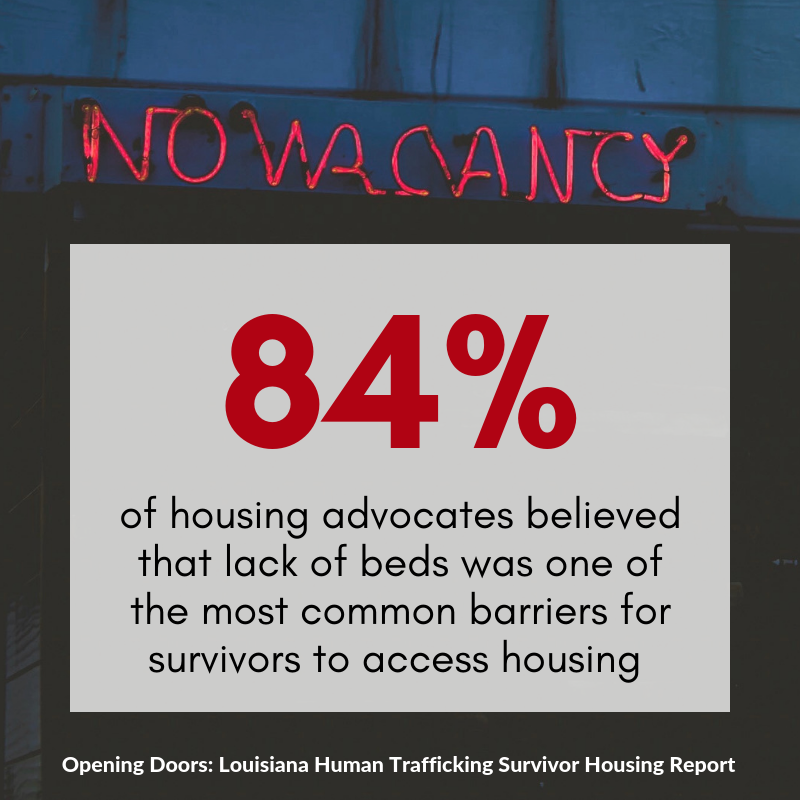
The report found that there are few specialized housing options in Louisiana- only 46 total, which are only available to female sex trafficking survivors. The report found that 84% of housing advocates serving trafficking survivors believe that there are not enough general housing or specialized housing options for trafficking survivors in Louisiana. See the flow chart below to learn which trafficking survivors have access to specialized housing services. Adults with children, labor trafficking survivors, males, and trans/non-binary/gender non-conforming individuals had fewer general housing options and no specialized housing options.


Process Phase
This report illuminates a contrast between the perspectives of housing providers and housing advocates in the process phase of housing. Important topics that highlight the contrasting points of view include: perceptions of bed availability and shelter fullness, intake process speed, and intake rigidity. For example, housing providers have a wide range of responses about how often they are full, which contrasted with housing advocate perception that beds are constantly full or unavailable. 56% of housing providers said they are full 60% or more of the time. Housing advocates identified that many clients were being screened out during the intake process, due to issues like history of behavioral health issues, mental health, criminal history, substance use, and cooperation with law enforcement.

Service Phase
Housing providers and housing advocates expressed varying degrees of success housing survivors. Stabilization was identified as the top success in the service phase by both housing providers and advocates. Stabilization is a process of helping survivors feel more safe, addressing basic needs, and addressing the survivor's acute needs. The most common successes housing providers identified were short and long term stability; and the most common success identified by housing advocates was general stabilization.
However, when we coded the responses of housing advocates we found that “no success” was the second most common phrase used to describe successes in the housing process. Housing advocates reported that a large portion of the survivors they serve do not make it into housing programs due to factors including identity, bed availability, and behavioral health. The most common challenge that housing providers identified in the service phase of housing is that survivors prematurely exit housing programs (such as running away, relapsing, or returning to their abuser).


Moving Forward: Next steps
This report marks the beginning of a data-informed conversation about housing for human trafficking survivors in Louisiana. Here are some ways that the community can take steps to build upon this information:
Convene a summit with key stakeholders (survivors, housing providers, advocates) to discuss the success and gaps identified in this report to discuss ways to improve survivor outcomes in the housing process.
Implement this housing project for a second iteration in 2-3 years to see how the landscape has changed in Louisiana.
Apply for funding to support the expansion of existing housing programs or development of trauma-informed, survivor-centered housing programs that serve trafficking survivors- particularly those who do not currently have specialized housing options.
Support future research that explore topics identified as key issues in this report, such as: how often shelters are full or at-capacity, which client demographics are successfully accessing housing, what housing success looks like for trafficking survivors and providers, and what alternative housing options (outside of the housing service provider landscape assessed in this report, such as therapeutic foster care programs) are available to trafficking survivors.
Conduct program evaluations of existing housing programs to understand client outcomes in the service phase of the housing process, and assess potential opportunities to improve housing accessibility and outcomes for survivors.
To learn more about the housing project and to download the report, visit http://www.nolatrafficking.org/research.
--
The Greater New Orleans Human Trafficking Task Force is a coalition of more than 80 state, civil society, and citizen organizers, the Task Force is committed to the prevention of human trafficking in the Greater New Orleans area through education, outreach, and collaboration. The Task Force’s primary goal is to collaborate in sharing and disseminating information, contacts, and protocols related to the existence, prevention, and response to human trafficking in New Orleans.

Special Guest Appearance on the "Speaker for the Living" Podcast
The GNOHTTF Task Force Coordinator sat down with Speaker for the Living, a podcast "exploring human trafficking, forced labor, and all things related", to discuss what survivor services look like for trafficking victims in the Greater New Orleans region.
The Task Force Coordinator from the GNOHTTF sat down with Speaker for the Living, a podcast "exploring human trafficking, forced labor, and all things related", to discuss survivor services and collaboration in the anti-trafficking movement.
Listen in to the podcast here: http://speakerfortheliving.com/services-for-survivors-of-human-trafficking/

COVENANT HOUSE NEW ORLEANS: What You Can Do To Combat Trafficking
At the end of nearly every training event, an audience member will ask me, “So what can I do to combat human trafficking?” Though this global crime can seem daunting to address, everyone has a role to play. No matter who you are, how old you are, where you work, or where you live: anyone can ‘EASE’ into supporting this movement.
Human Trafficking Awareness Month Blog:
What You Can Do To Combat Trafficking
Read the blog directly on the Covenant House New Orleans website at https://www.covenanthousenola.org/843-2/
—
By: Leanne McCallum, Task Force Coordinator, Greater New Orleans Human Trafficking Task Force
At the end of nearly every training event, an audience member will ask me, “So what can I do to combat human trafficking?” Though this global crime can seem daunting to address, everyone has a role to play. No matter who you are, how old you are, where you work, or where you live: anyone can ‘EASE’ into supporting this movement.
Here are examples of what you can do today to combat human trafficking.
E: Educate
The first step to addressing the human trafficking epidemic is to understand what human trafficking is, and what it looks like in your community.
Learn what human trafficking is (and isn’t). Human trafficking is when a person is compelled by a trafficker through force, fraud, or coercion for the purposes of commercial sexual activities or labor. Human trafficking is an international crime, but it’s also happening right here in the Greater New Orleans region. Once you know the signs, share the information with your friends, family, and children so they’re aware too!
Seek out information to identify the signs of trafficking, and get informed about how the crime may be occurring in your community. Polaris, DHS Blue Campaign, and the Task Force website have resources that explain the who, what, and why about human trafficking in the United States.
Attend or request a training for your business, community organization, or other associations to learn more about human trafficking risks, indicators, and resources in your local community. Get notifications and updates from news sources such as the CNN Freedom Project.
A: Advocate
Every citizen has the power to advocate for change- whether its in your workplace, community, or country.
Call your state senator or representatives about legislation that supports trafficking victims and survivors. There is national legislation such as the TVPA Reauthorization, along with a long list of other proposed bills that address human trafficking.
See how the places that you work, worship, and/or volunteer address human trafficking internally. Advocate for your organization to create a human trafficking response protocol. Inquire whether work practices ensure that people are fairly, safely, and legally employed. Check into your company’s employee volunteer program, and see how your business can engage with local organizations who serve trafficking victims and survivors.
Request information about the supply chain of products that your organization uses to ensure it employs responsible sourcing, and advocate for your company to use a slavery-free products and suppliers. Encourage the organization to provide employment opportunities to survivors of trafficking.
S: Scrutinize
Be a conscious community member who scrutinizes where you live, the places you patronize, and the items that you purchase.
There are many smartphone applications such as Slavery footprint, Free2Work, and the Slave-Free Shopping Guide that can help you check the trafficking impact of products you buy. This can help you be a conscious consumer to avoid purchasing products made using slave labor. In addition, you can purchase products that have verified ethical labor certifications such as ‘fair trade’.
As a consumer you are able to control where you go for food, drinks, and entertainment. Human trafficking happens within the hospitality industry, especially in cities like New Orleans where tourism is an integral part of the economy. Check into whether your favorite establishments have fair wages and ethical employment standards, or whether the establishment has a history of criminal activity.
Finally, be aware of your neighborhood and surroundings. If you see something that looks suspicious, say something. Contact the Polaris Hotline or the national law enforcement tip line if you see something that may be trafficking. You can also connect to local resources through the Task Force to notify local agencies about a potential trafficking situation.
E: Engage
Engage in the Greater New Orleans community’s anti-trafficking efforts.
Become a task force member and engage in task force activities. Take part in the community’s response to trafficking by participating on a task force committee, or attending a task force sponsored events.
Host awareness-raising events or fundraisers in your community to help others ‘ease’ into the fight to combat human trafficking. For example, you can show a human trafficking documentary or film and host a discussion. Or you can host a fundraising event and donate the proceeds to an anti-trafficking organization.
Subscribe to the Task Force newsletter to get monthly updates on events, training opportunities, and human trafficking news. Follow anti-trafficking organizations like the Task Force on social mediaplatforms like Twitter and Facebook.
And of course, you can always Donate.
Contributing in-kind goods to organizations fighting trafficking is critical to serve victims and survivors of trafficking. Clothing, baby supplies, and gift cards are examples of items that can assist survivors as they rebuild their lives.
You can donate your time and expertise by volunteering for local organizations who do anti-trafficking work.
And of course, you can donate money to organizations who are the boots on the ground serving trafficking victims and survivors.
These are just a few ways that you can take steps to contribute to the fight against human trafficking. Now that you have some tools to ‘EASE’’ into this, I have a question for you: What will you be doing to combat trafficking in your community?
—
Start to advocate and engage by sharing this post on social media with the hashtag #HumanTraffickingAwarenessDay